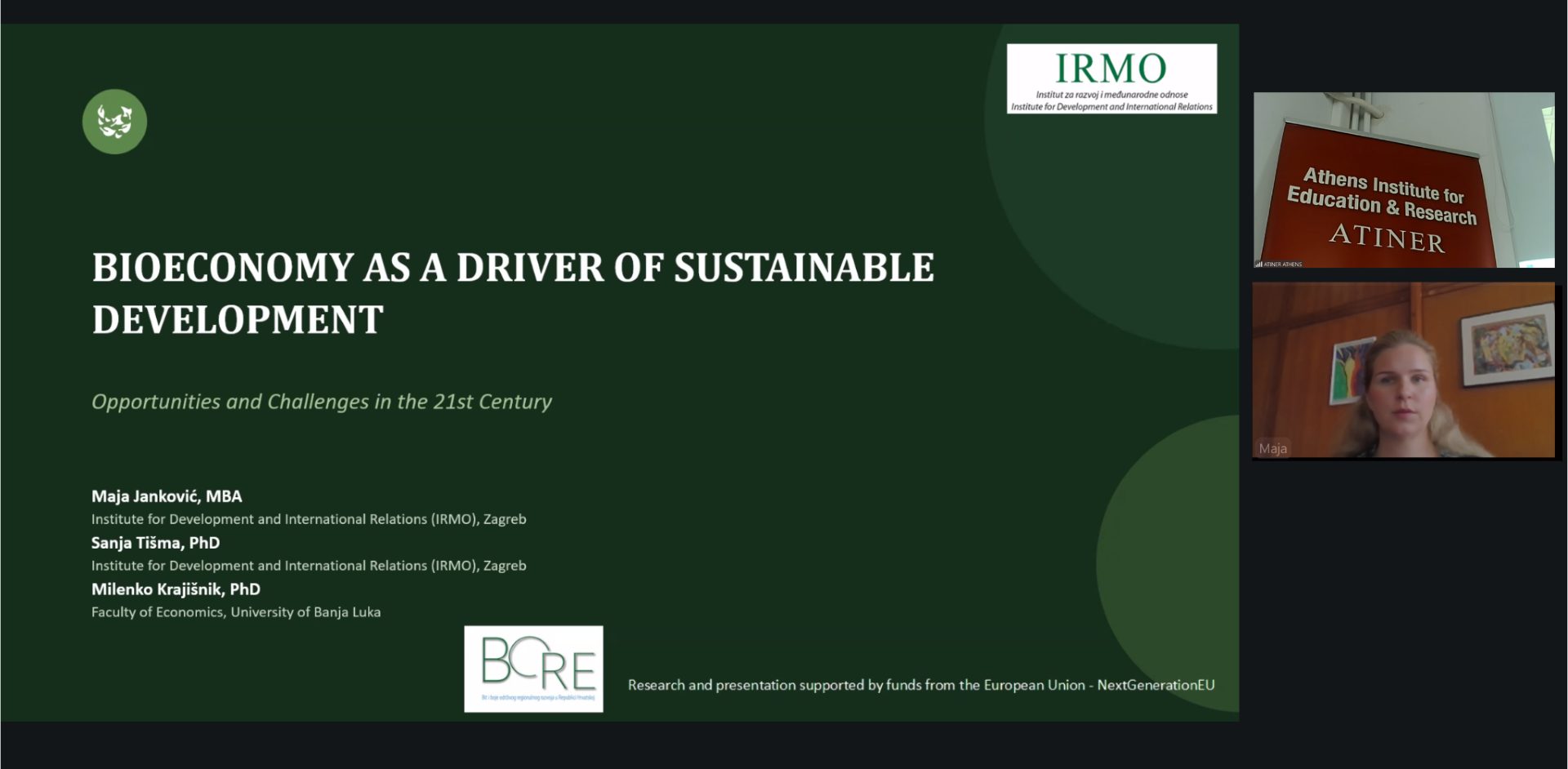
Maja Janković, MBA, from the Institute for Development and International Relations (IRMO) participated online in the international scientific conference “14th Annual International Conference on Ecology, Ecosystems and Climate Change,” organized by ATINER (Athens Institute for Education and Research) and held in Athens.
At the conference, she presented a scientific paper titled “Bioeconomy as a Driver of Sustainable Development: Opportunities and Challenges in the 21st Century,” co-authored with Sanja Tišma (IRMO) and Milenko Krajišnik (Faculty of Economics, University of Banja Luka).
The paper analyses the contribution of the bioeconomy to achieving the United Nations Sustainable Development Goals (SDGs), with particular emphasis on responsible consumption and production, climate action, and decent work and economic growth. The authors employed a combination of policy analysis, a systematic literature review, and research conducted through a survey.
The results of the research show that 66.5% of respondents believe the bioeconomy can make a significant contribution to sustainable development, yet only 26.7% state that they are genuinely familiar with the concept, pointing to a clear gap between support and understanding. Furthermore, only 33.8% of respondents are willing to pay a 10–15% higher price for products made from agricultural waste, while respondents identify the main barrier to wider adoption of bio-based products not as price, but as a lack of information (37.4%). Finally, 74.1% of respondents believe that the role of the state, through subsidies and regulation, is key to the development of the bioeconomy.